Should You Bid On Brand Terms? Bing Ads Releases Studies On Retail And Travel Brands -
Bing Ads analyzed where people click when a brand ad shows and doesn't on brand search results pages.
Bing ads has released more research on the much-debated topic of whether advertisers should bid on their brand terms in paid search. Following up on a study published last year, the new studies focus on the retail and travel verticals specifically.
The team analyzed 3 million desktop impressions on results pages for retail brand terms and 400,000 desktop impressions on travel brand results pages and looked at where people click when brand ads were and were not present. Did clicks go to the brand or a competitor, and is there incremental benefit when brands own both the top ad and organic listings?
We’ll dive into the data, but in short, as it did in its prior research, Bing Ads found that when an advertiser bids on its brand terms they receive more clicks overall and keep more clicks from going to competitors’ listings on their brand results pages.
Here’s how the data breaks down:
When brands did not display a brand ad on their results pages, retail brands received 60 percent of the clicks to their top organic listing, on brand travel results pages 61 percent of people clicked the brands’ top organic listing. But, when the brands had ads in the top mainline position, retail brands received 91 percent of the clicks and travel brands scored 88 percent of the clicks on their results pages. That’s a gain of 31 percent more clicks for retail brands and 27 percent more for travel brands when a brand ad displays.
Bing Ads then looked at how those clicks are distributed between the ads and organic listings. In retail, 42 percent of the clicks went to the brand ad and 49 percent went to the brand’s organic listing. In travel, the clicks were more evenly distributed with 45 percent going to the brand ad and 43 percent to the brand’s organic listing.
Next up was to look at cannibalization. Do brand ads simply divert free traffic to paid clicks? The data showed that 11 percent of retail brand ad clicks and 18 percent of travel brand ad clicks likely would have gone to the organic listing anyway. But, that the gains in overall click activity were incremental.

Incremental paid clicks on retail brand ads. Source: Bing Ads Internal Data, Dec. 2014.
Brand Ads for Defense
The research team also looked at the impact brand ads had on keeping users from clicking on other listings.
In the retail sector, when a retail brand was not running brand ads, 34 percent of the missed clicks went to other ads and 6 percent went to other organic listings.
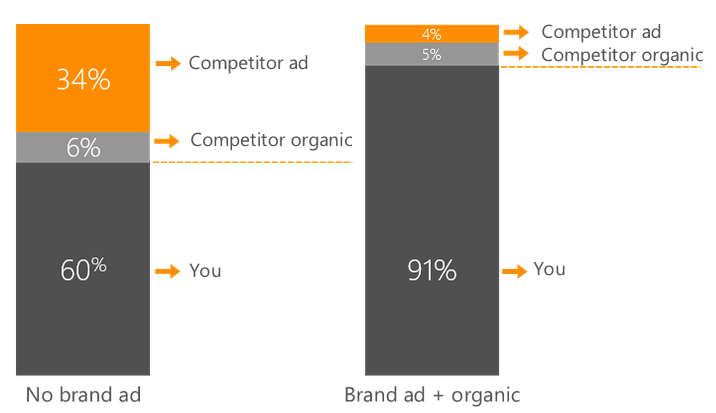
Retail brands give up clicks to competitors when a brand ad is not present. Source: Bing Ads internal data, Dec. 2014.
In travel the split was almost even: 20 percent of clicks went to other ads and 19 percent went to other organic listings when the brands did not run ads on their brand terms.
While the overall trends were similar in both verticals, the data shows that in retail there is much more competition from other advertisers and less of a threat of losing clicks to other organic listings. But in travel, the brand ads help defend just as strongly against both SEO and advertiser campaigns from their competitors.

